One of the things I have realized after years of living with disabling illness is how much the beliefs and concepts we have about ourselves, our illnesses and the world influence our lives, our relationships, and how happy or content we are.
We all have beliefs/concepts/rules about ourselves, other people, and the world. These beliefs help us make sense of our world and our experience in it. Our lives are filled with so much sensory stimulation and so many events happening that our brains use beliefs and concepts to help us make our lives understandable and manageable.
Where problems can come is when we think our beliefs and concepts are real and true, immutable and unchangeable – and often they’re just ways of thinking we were taught when we were young. They may have been helpful at one time, but can become less helpful and even harmful over time.
Thinking a bit about our beliefs and concepts is not going to cure our illnesses, but it can help us live more happily. We can learn to hold on to beliefs that are helpful, and turn away from beliefs and concepts that aren’t helpful.
I remember when I really got it, that my conscious and unconscious beliefs had an enormous impact on my life. It was a bit odd at first, trying to look at underlying beliefs instead of just assuming x and y, but over the years it has become a habit. When I started the process I realized how many of the beliefs and concepts I took for granted were unprovable and often logically impossible.
I realized how many of my ideas about myself, other people, and the world were profoundly unfair and unhelpful. I realized that even though I’m a logical person (yes, I loved Spock as a kid), many of my beliefs were not logical, they were products of childhood experience and emotion, and more importantly, influenced and continue to influence me on a daily basis.
Have you ever had a discussion with someone where no matter what you said, and no matter how much logic or how many facts you used it made no difference? Or maybe they would agree but then go back to their original belief? It is because that belief was grounded in emotion – not from any type of analysis or logic – so it did not matter if you proved your point or if your argument was logical. You still lost the argument.
Some beliefs are based in logical evidence, for example – I believe the sun will rise tomorrow, and unless the sun suddenly goes super nova, it will indeed rise. But how about racist beliefs? I’ve had two people in the past year tell me that “All Jews are greedy and rich”. They both really believed it. But if they had done even a little research or even thought logically about how impossible that was, they would have realized that there are rich Jews and poor Jews. Did they think that every Jew lived in mansion? Did they think that there were no Jews living in poverty? Did they really believe it was possible that every member of a specific group was anything?
We also hold profound beliefs about ourselves that are totally untrue – but that nevertheless influence how we think and act on a daily basis. To give a personal example, I used to have a belief that very few people loved or cared for me, and that I was not a lovable person (well, I still have this mental pattern, but I work with it).
Many years ago, at the end of a meditation retreat, I was saying goodbye to the lama leading the retreat, feeling awkward, unliked, and unloved, looking him right in the eye, and only seeing neutrality on his face. I felt like he did not particularly like me, care about me or think that in any way I had value. I rationalized it by thinking “well, he hasn’t known me that long, why should I expect him to love me or even like me like he does his old students?”
A few weeks later, someone sent me a picture that had been taken at the very moment when I was feeling this neutrality, and when I looked at the photo I was stunned, and honestly my entire view of myself was shaken – in the photo, I was looking directly at him, and he was looking directly at me with a huge smile of total love.
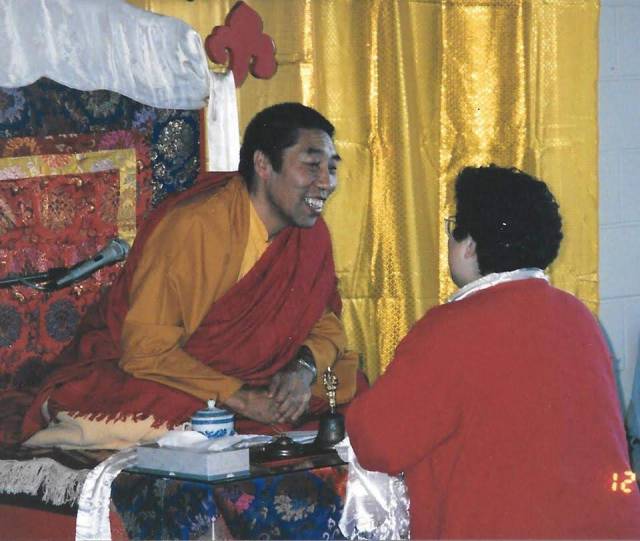 I kept looking at the photo, I couldn’t believe that what I had thought and felt was so completely wrong. I showed the photo to all sorts of people, and without telling them anything about the photo I just asked them what they saw. Every single one of them said “He loves you so much”, “he’s got such a loving smile on his face”. It was like I had been hit over the head with a brick, realizing my concepts about myself had not only led me to not see or feel the smile and love, but had led me to the exact opposite idea.
I realized that not only was my perception completely incorrect, but I realized how possible it is to totally misunderstand a situation because of underlying beliefs. I realized how those feelings I had of being unloved were just emotions based on an incorrect belief, and were just untrue.
Clearly even though I felt unloved – I was loved. For two years after that retreat I kept that photo on my mantel to remind myself how much my underlying beliefs could influence me.
Twenty odd years later I can say that even though feelings of being unlovable and unloved still come up, I notice them now and know they are untrue. Knowing that belief was untrue started to open me to both seeing and feeling the love others have for me, and that opened me up to loving others. On a day to day basis it makes a difference.
Just as an example, I had a friend staying with me last weekend and I had two nights of limited sleep due to pain. My friend asked me why I didn’t sleep so well, and I could feel the warmth of his love and care for me, and even though I was still in pain, that warmth helped me relax, cope with the pain, and I felt love and happiness instead of just the misery of pain.
My point in telling these personal stories is to emphasize how our beliefs have a profound impact on our emotions and our lives.
My point in talking about beliefs in a blog about disabling illness is that we all have beliefs about illness, and we are surrounded by others who also have beliefs about illness, and by being willing to really look at them we can keep what helps, discard what isn’t helpful, and can start living happier lives.
In another blog post, or maybe even a few blog posts I plan to write more about beliefs and illness.

